
Track Customer Sentiment with AI
Analyze customer emotions across case interactions and sales activities inside Salesforce using GPTfy's AI-powered sentiment analysis
Customer satisfaction drops. You find out too late.
Sentiment signals exist across every channel in your CRM. But without AI, teams discover unhappy customers only when they churn or escalate.
Happens without any warning signal reaching the account team
Customers express frustration across emails, case comments, and call notes. But no one aggregates these signals into a trend. By the time the renewal conversation starts, the decision to leave was made months ago.
“Finally an easy to use AI solution which would not only help you manage daily tasks efficiently but also give you the power to interpret large datasets to make business decisions effectively.”
- Ashwin Kotian, AVP, ICICI Lombard
Build prompts with Prompt BuilderSentiment data scattered with no unified view
Cases, emails, chat transcripts, call logs, and activity notes each hold fragments of customer mood. Agents re-read entire threads to gauge tone. Managers ask "how is this customer feeling?" and get guesses instead of data.
“The implementation was smooth and the results exceeded expectations.”
- Rishi Golyan, Salesforce Consultant, Algocirrus
Connect your model via BYOM ArchitectureNo visibility into how sentiment changes over time
A single interaction might look fine. But three months of gradually declining tone tells a different story. Without trend analysis, teams treat every touchpoint as isolated and miss the trajectory that predicts churn.
“Saw this Freemium App and thought to give it a try. I am not disappointed. I find it better compared to SFDC AI cloud.”
- Amar Rawal, Business Analyst, Origin
Secure this with Security LayerReplace Guesswork with Insight
End the endless re-reading of conversation threads
Stop wasting hours analyzing tone in conversation threads. Support agents and sales reps spend precious minutes on emotional detective work instead of solving problems or closing deals. Without structured sentiment data, teams guess at customer mood and often get it wrong.
AI-powered emotional intelligence through Data Context Mapping
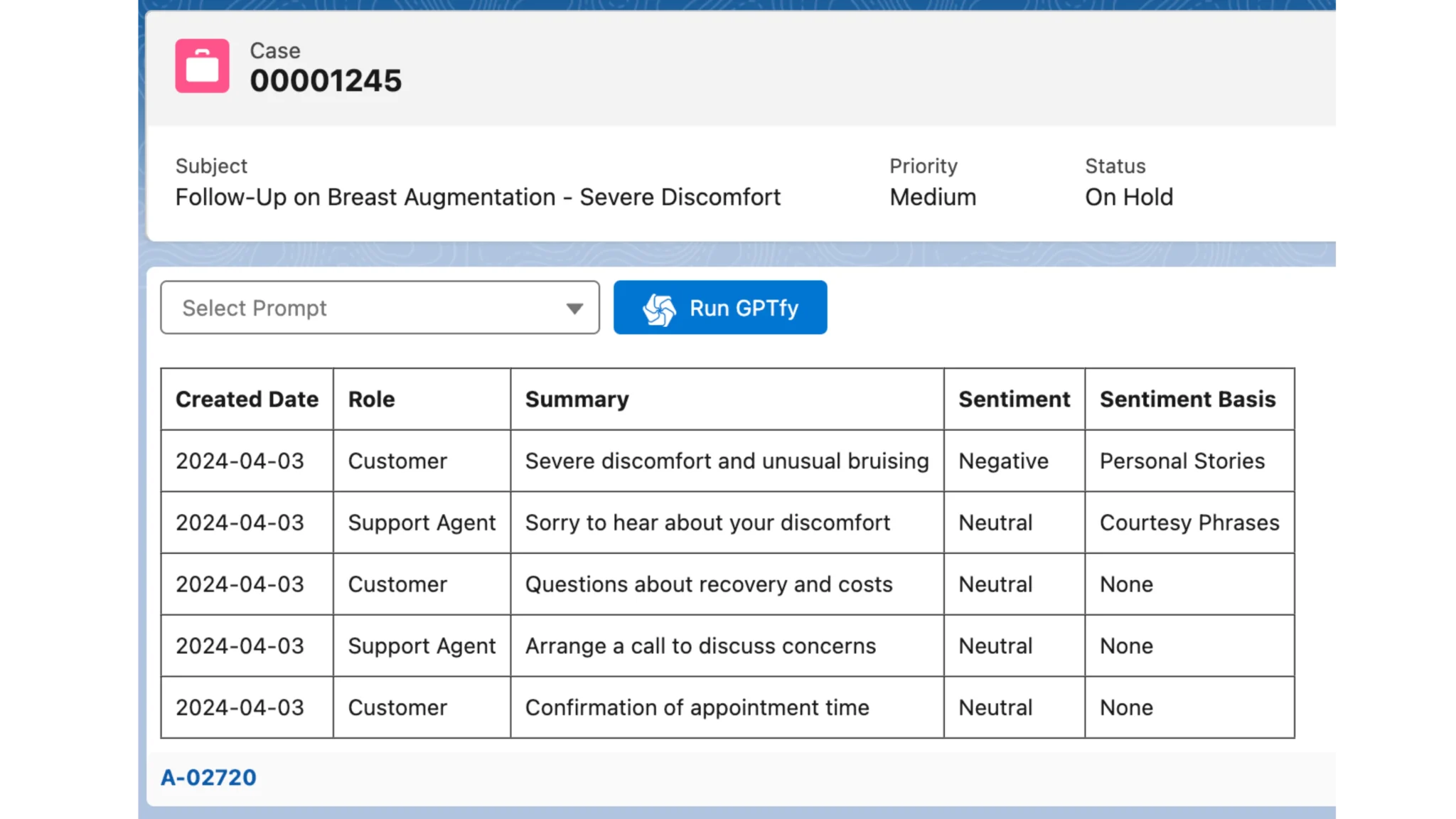
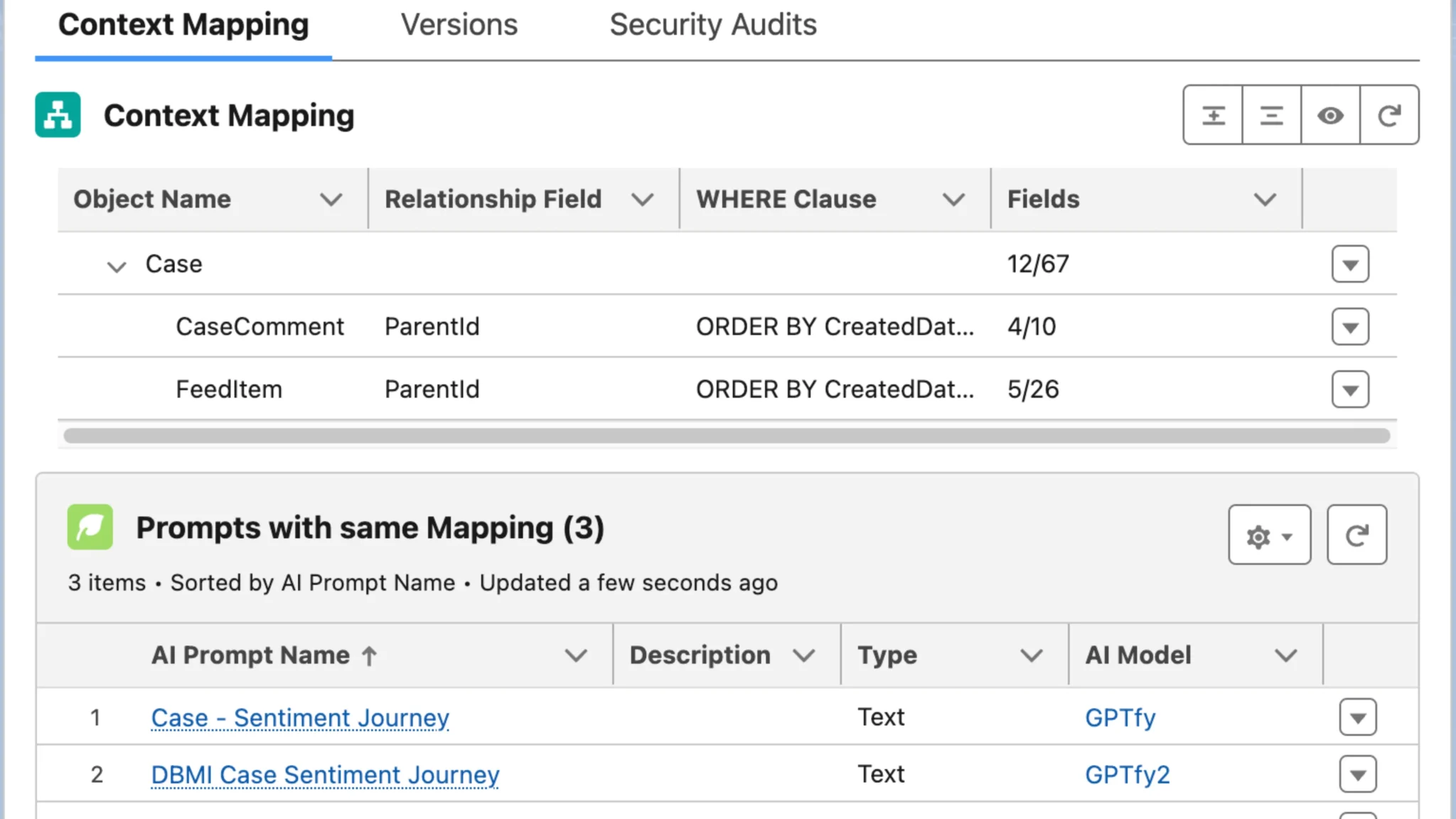
AI analyzes customer emotional journey when you need it. GPTfy's Data Context Mapping pulls case comments, email threads, and activity notes into the AI model, which maps sentiment shifts across interactions. See if customers became satisfied or if mood is declining without re-reading conversations, triggered via Salesforce Flow or on-demand.
Secure Sentiment Processing
Advanced sentiment processing with customizable analysis frameworks
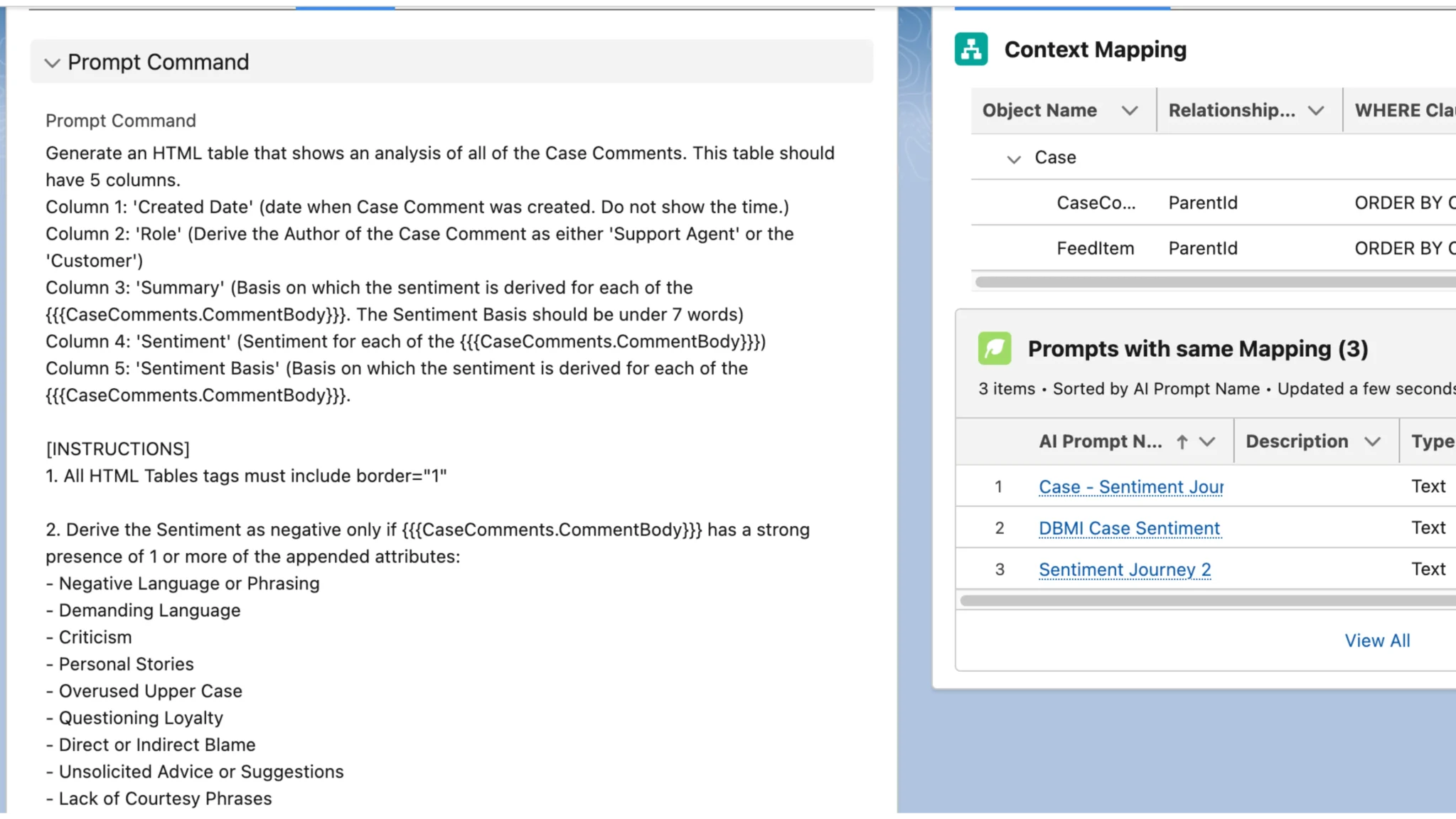
AI creates clear tables showing who said what, sentiment, and explanations. The Prompt Builder lets admins customize sentiment categories, scoring scales, and output formats to match your team's existing frameworks and reporting requirements.
Enterprise-grade security via PII masking and Named Credentials
Data stays secure in your infrastructure. GPTfy masks PII before AI processing through the Security Layer, and all model connections use Salesforce Named Credentials. Choose OpenAI, Claude, Gemini, or other models based on your compliance and quality requirements.
Build Stronger Relationships
Respond with appropriate empathy using real sentiment data
Understand customer emotions at a glance. Teams respond with appropriate empathy and urgency based on real sentiment data extracted from actual interactions. When an agent sees that a customer's mood has shifted from satisfied to frustrated over three interactions, they adjust their approach before the situation escalates.
Measurable improvement through sentiment-informed responses
Reduce resolution times, increase satisfaction scores. Build stronger connections by responding to technical issues and human emotions together. The AI grounds every sentiment assessment in specific interaction evidence, so teams act on data rather than assumptions.
Why Choose Sentiment Journey
Real-Time Sentiment Visibility
See customer mood shifts as they happen across cases, emails, and activities. Teams act on live emotional signals instead of discovering dissatisfaction weeks later.
Proactive Intervention Before Escalation
AI flags declining sentiment patterns early so agents re-engage before frustration becomes a formal complaint. Catch the warning signs that manual reviews miss.
Data-Driven QBR Preparation
Replace anecdotal customer health reports with structured sentiment trend data. Walk into quarterly business reviews with evidence-backed relationship scores across every account.
Powerful Capabilities
Multi-Channel Sentiment Scoring
AI scores emotional tone across case comments, email threads, call notes, and activity logs, producing a unified sentiment view per customer from every interaction channel.
Trend Tracking Over Time
Monitor how customer sentiment evolves across interactions. Spot gradual mood declines that individual touchpoints mask but trend lines reveal clearly.
Escalation Alerts
Automatic flags when sentiment drops below configurable thresholds. Teams receive actionable alerts tied to specific interactions that triggered the decline.
Journey Visualization
Structured sentiment maps showing emotional trajectory across the full customer lifecycle. See exactly when and why satisfaction shifted at each stage.
Key Takeaways
- Data Context Mapping pulls case comments, email threads, and activity notes into analysis
- AI maps sentiment shifts across interactions to visualize the customer journey
- Prompt Builder defines custom sentiment categories, scoring scales, and output formats
- PII masking protects customer data before any interaction text reaches the AI model
- Triggered via Salesforce Flow on case updates or run on-demand from any record
Frequently Asked Questions
GPTfy's Data Context Mapping pulls case comments, email threads, and activity notes into the AI model. The model analyzes language patterns, tone shifts, and emotional signals across interactions to produce structured sentiment reports with evidence from specific messages.
Yes. GPTfy prompts can be triggered via Salesforce Flow, so sentiment analysis runs automatically when cases are updated, emails arrive, or activities are logged. Teams can also run sentiment analysis on-demand from any record.
Yes. The Prompt Builder lets admins define custom sentiment categories, scoring scales, and output formats. You can align sentiment analysis with your existing customer experience frameworks and reporting requirements.
GPTfy's Security Layer masks personally identifiable information before any interaction data reaches the AI model. All processing flows through Salesforce Named Credentials with full audit logging, ensuring compliance with data protection requirements.
GPTfy is a Salesforce-native managed package that installs in minutes. Configuring sentiment analysis involves creating a prompt template in the Prompt Builder and setting up a Data Context Mapping to define which case and activity fields feed into the analysis. Most teams are running sentiment tracking within a day of installation.
Yes. GPTfy executes sentiment analysis as individual prompt invocations triggered via Salesforce Flow, so it scales with your org's transaction volume. You can run analysis on-demand for specific records or automate it across your entire case portfolio using batch Flow triggers.
See Sentiment Analysis on Your Data
Book a demo to see how GPTfy tracks customer sentiment across your Salesforce interactions.
Related Use Cases
Customer Retention
Predict churn risk and automate renewal workflows with AI.
Case Summarization
Auto-generate concise case summaries from full conversation history.
Root Cause Analysis
Identify recurring issue patterns across support cases with AI.
Case Resolution
AI-recommended solutions based on similar resolved cases.
AI for Service
All AI-powered service use cases for Salesforce.