
Generate Articles from Cases
Turn resolved Salesforce cases into structured knowledge articles automatically using GPTfy's Data Context Mapping and Prompt Builder
Your knowledge base has answers. Nobody finds them.
Knowledge articles exist but agents cannot locate them. Outdated content stays published. Duplicate articles give conflicting answers. The knowledge base grows but usefulness declines.
Of agents cannot find the right article
Keyword search fails when agents describe problems differently than how articles are titled. Agents give up searching and handle cases from scratch, ignoring hundreds of existing solutions sitting in the knowledge base.
“It enables Salesforce professionals like me to leverage AI of my choice in a declarative manner. Case summarization, classification, routing, personalized email response generation.”
- Sury Ramamurthy, Technical Architect, Innolake Corporation
Ground answers with RAG engineOf knowledge content is outdated or stale
Articles written for previous product versions stay published with no review flag. Agents follow outdated resolution steps, fail to resolve the issue, and escalate cases that should have been straightforward.
“Really nice App. It does what it claims. Pre-packaged prompts make it easy to use.”
- Shailesh Varshney, Developer, Capgemini Australia
Build prompts with Prompt BuilderDuplicate articles giving conflicting answers
Multiple agents write articles for the same issue with different resolution steps. Customers and agents find contradictory guidance, eroding trust in the knowledge base and increasing case reopen rates.
“GPTfy accurately understands user input and generates high-quality content in the right format.”
- Ankita Dhamgaya, Director and Founder, AlgoCirrus
Secure this with Security LayerKnowledge Locked in Cases
Manual article creation falls behind
Support teams resolve hundreds of cases per week, but fewer than 5% become knowledge articles. Writing an article from a resolved case takes 20-30 minutes: reading the case history, extracting the resolution steps, formatting the content, and categorizing it. Most agents skip this step because their next case is already waiting.
Generate draft articles via AI
GPTfy's Data Context Mapping pulls the case description, resolution steps, email thread, internal comments, and related product fields from closed cases. The AI generates a structured knowledge article with a clear title, problem statement, step-by-step resolution, and suggested category. Articles reference the original case number for traceability.
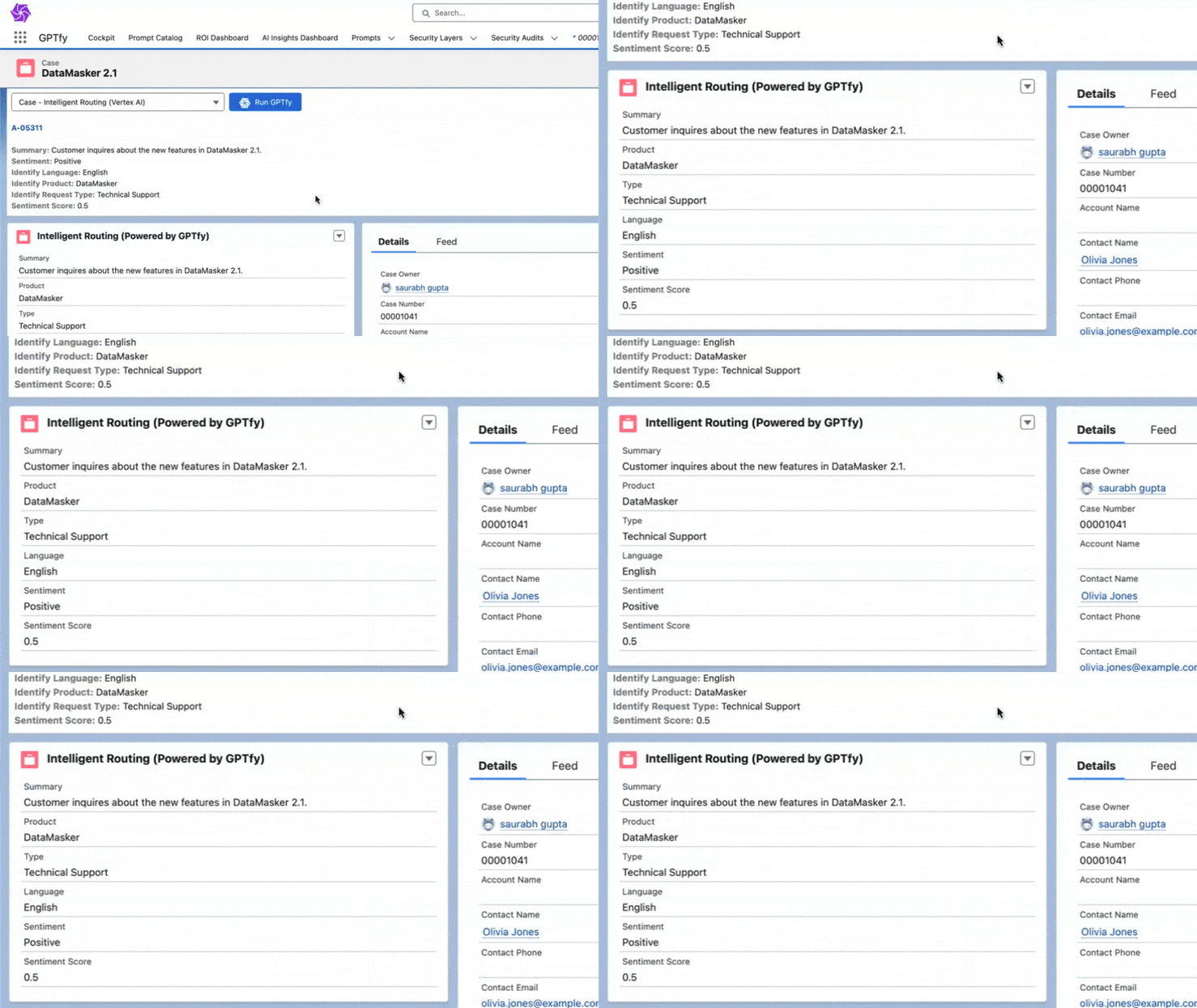
Articles Grounded in Data
Every article traces to a case
When the AI generates an article titled 'Resolving API Authentication Timeout in Production,' the resolution steps come from the actual case comments and email exchanges where the agent solved the problem. GPTfy's Prompt Catalog enforces evidence-binding rules so articles reference specific case numbers, product versions, and configuration steps from your org.
Customizable templates with Prompt Builder
Use GPTfy's no-code Prompt Builder to define article format: troubleshooting guides, how-to articles, FAQ entries, or technical reference documents. Each template specifies which case fields to include, what structure the article follows, and what metadata to generate (categories, keywords, product tags).
Enterprise Security for Content
PII masking removes customer details
Case resolution data often contains customer-specific details: company names, contact information, contract terms, and configuration details. GPTfy's Security Layer masks personally identifiable information before sending case data to any AI model. The generated articles contain clean, reusable resolution steps without customer-specific PII.
Generate articles with any model
Create knowledge articles through OpenAI GPT-4o, Anthropic Claude, Google Gemini, or Azure OpenAI. GPTfy's AI Connection framework uses Salesforce Named Credentials for each provider. Switch models based on article quality requirements without changing your workflow.
Why Choose Knowledge Article Management
Faster Knowledge Retrieval
AI-powered search surfaces the right article in seconds by matching case context to existing knowledge content - eliminating the keyword-guessing game agents play with traditional search.
Improved Article Quality
Every generated article includes structured resolution steps, product version references, and original case traceability. Consistent formatting and evidence-binding produce articles agents actually trust and use.
Reduced Duplicate Articles
Content gap detection identifies existing articles that cover the same resolution before creating a new one. Duplicate and conflicting content gets flagged automatically, keeping your knowledge base clean and authoritative.
Powerful Capabilities
AI-Powered Search
GPTfy matches incoming case context against your full knowledge base using semantic search - finding relevant articles even when the agent's search terms don't match the article's exact keywords.
Content Gap Detection
The AI identifies case clusters with no matching knowledge article, surfacing the topics where your knowledge base has blind spots and prioritizing which articles to create first.
Auto-Article Drafting
Data Context Mapping pulls case description, resolution steps, email thread, and internal comments from closed cases. The AI generates a structured draft article with title, problem statement, step-by-step fix, and suggested category.
Usage Analytics
Track which articles agents use most, which get skipped, and which cases close without any article reference. Usage data feeds back into content gap detection to continuously improve your knowledge base.
Key Takeaways
- Data Context Mapping extracts resolution steps from closed cases into draft articles
- Each generated article references the original case number for traceability
- Content gap detection identifies case clusters with no matching knowledge article
- Security Layer masks customer-specific PII so articles contain clean resolution steps
- Prompt Builder defines article templates: troubleshooting, how-to, FAQ, or reference
Frequently Asked Questions
GPTfy's Data Context Mapping pulls case descriptions, resolution steps, email threads, internal comments, and product fields from closed cases. The AI generates a structured article with title, problem statement, step-by-step resolution, and suggested category, all referencing the original case number for traceability.
Yes. GPTfy's Security Layer masks personally identifiable information (company names, contact details, contract terms) before case data reaches the AI model. Generated articles contain clean, reusable resolution steps without customer-specific PII.
Absolutely. GPTfy's Prompt Builder lets you define article templates for troubleshooting guides, how-to articles, FAQ entries, or technical reference documents. Each template specifies which case fields to include, the article structure, and what metadata to generate.
GPTfy generates structured knowledge articles with clear titles, problem statements, step-by-step resolution instructions, and category suggestions. Each article references specific case numbers and product versions from your org, making them immediately usable by other agents and customers.
GPTfy installs as a Salesforce managed package in minutes. Once installed, admins configure a Data Context Mapping to select which case fields feed into the AI prompt and create an article generation template in the Prompt Builder. Most teams generate their first draft article within hours of setup.
Yes. GPTfy's article generation runs as individual prompt executions that can be triggered via Salesforce Flow on case closure. This architecture scales with your case volume without requiring batch processing queues. You can also filter which cases trigger generation based on case type, product area, or resolution complexity.
See Article Generation in Action
Watch GPTfy generate structured knowledge articles from your resolved Salesforce cases in a live demo.
Related Use Cases
Case Resolution
AI-recommended solutions based on similar resolved cases.
RAG
Retrieval-augmented generation for answers grounded in your documents.
Case Summarization
Auto-generate concise case summaries from full conversation history.
Root Cause Analysis
Identify recurring issue patterns across support cases with AI.
AI for Service
All AI-powered service use cases for Salesforce.