
Draft RFP Responses from CRM Data
AI pulls product details, pricing history, and case data from Salesforce to generate accurate proposal sections using Data Context Mapping
RFP deadlines pass while your team writes from scratch
Solutions teams spend days assembling proposals manually when the data already exists in Salesforce.
Average time to assemble a single RFP response
Solutions engineers pull product specs from one system, pricing from another, and implementation timelines from project records. Ten RFPs a month means 40+ person-days lost to information assembly.
“GPTfy accurately understands user input and generates high-quality content in the right format.”
- Ankita Dhamgaya, Director and Founder, AlgoCirrus
Build prompts with Prompt BuilderOf proposals contain inconsistent product claims
Without a single source of truth, each rep describes capabilities differently. Pricing varies between proposals, implementation timelines contradict past commitments, and reviewers catch errors too late.
“It enables Salesforce professionals like me to leverage AI of my choice in a declarative manner. Case summarization, classification, routing, personalized email response generation.”
- Sury Ramamurthy, Technical Architect, Innolake Corporation
Ground answers with Retrieval-Augmented GenerationRFPs lost because knowledge is trapped in individual reps
Your best solutions engineer knows which case studies to cite and which compliance language to include. When they are unavailable, proposals ship with generic content that fails to differentiate.
“The implementation was smooth and the results exceeded expectations.”
- Rishi Golyan, Salesforce Consultant, Algocirrus
Secure this with Security LayerRFPs Take Days Unnecessarily
Manual RFP work drains your best people
A typical RFP response requires gathering product specifications from one system, pricing from another, implementation timelines from project records, and customer references from case history. Solutions engineers and sales teams spend 3-5 days assembling a single response, pulling data from Salesforce tabs, shared drives, and tribal knowledge. When you receive 10 RFPs a month, that is 40+ person-days lost to information assembly.
GPTfy assembles RFP context through Data Context Mapping
GPTfy's Data Context Mapping pulls relevant fields from Products, Opportunities, Cases, and custom objects in your org, then sends that structured data to the AI model of your choice. The AI generates draft response sections grounded in your actual product capabilities, pricing history, and implementation track record. Each response section references real Salesforce records, not generic marketing copy.
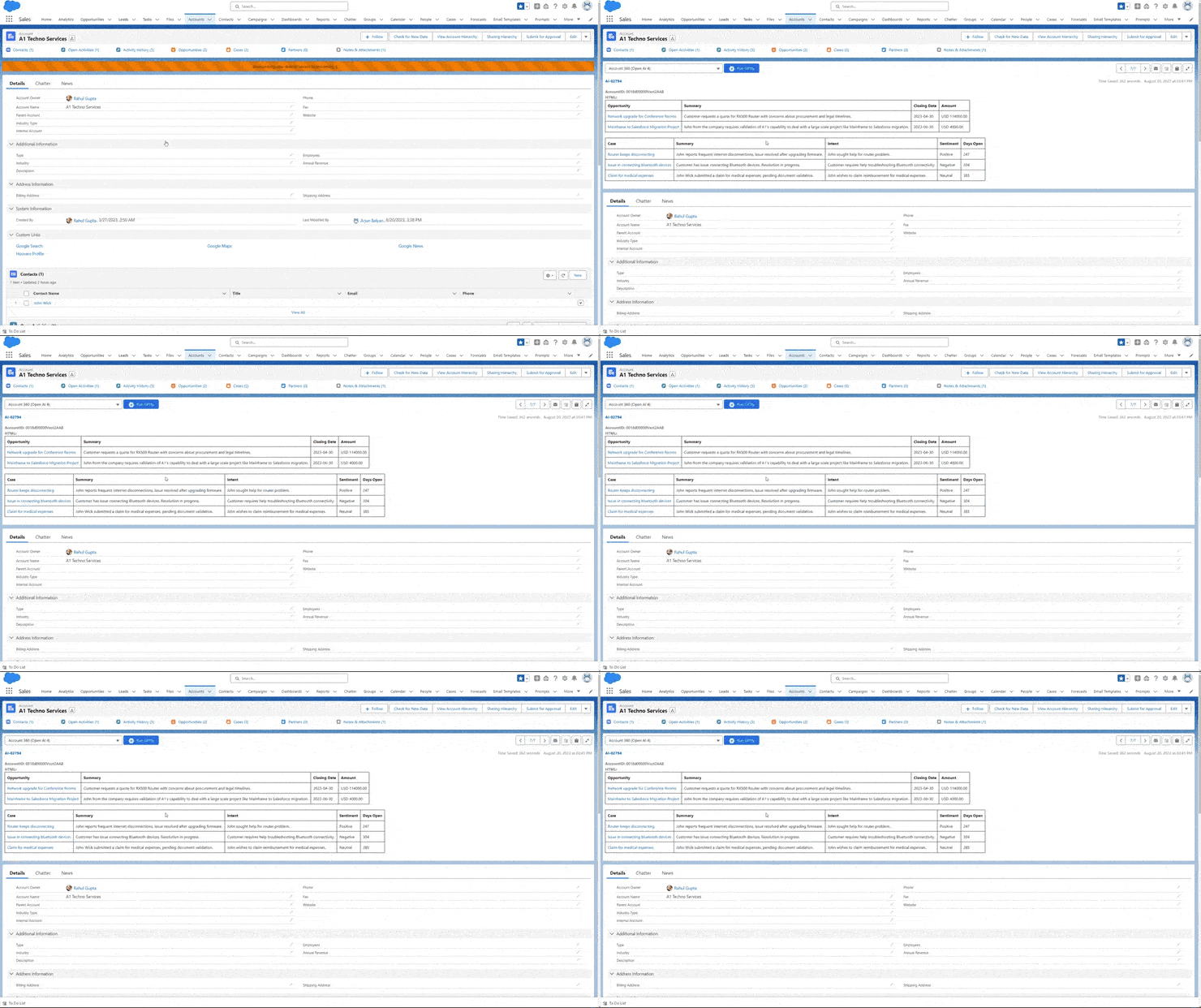
Responses Grounded in Data
Every claim traces back to a Salesforce record
When the AI writes 'Our average implementation time for enterprise deployments is 12 weeks based on 8 completed projects,' that number comes from your closed Opportunity records and their implementation milestone dates. GPTfy's Prompt Factory enforces evidence-binding rules that prevent the AI from making claims it cannot support with data from your org.
Reusable templates through the Prompt Builder
Use GPTfy's no-code Prompt Builder to create RFP response templates for different proposal sections: technical approach, pricing justification, implementation methodology, or customer references. Each template defines which Salesforce objects and fields to pull, what format the output follows, and what compliance language to include automatically.
Enterprise Security for Proposals
PII masking protects confidential data
RFP responses often reference customer names, contract values, and implementation details. GPTfy's security layer automatically masks personally identifiable information before sending data to any AI model. Customer names, deal amounts, and contact details are anonymized during processing and re-mapped in the final output.
Use any AI model via Named Credentials
Generate RFP drafts through OpenAI GPT-4o, Anthropic Claude, Google Gemini, or Azure OpenAI. GPTfy's BYOM architecture uses Salesforce Named Credentials for each provider. Your IT team controls which models are approved for proposal generation, and switching providers requires a configuration change, not a code rewrite.
Why Choose AI-Augmented RFPs
Faster RFP Response Time
Cut response assembly from 3-5 days to hours. GPTfy pulls product specs, pricing history, and implementation timelines from Salesforce automatically - no more hunting through tabs and shared drives.
Higher Quality Proposals
Every claim in your RFP response traces back to a real Salesforce record. Evidence-binding rules prevent the AI from fabricating stats, so reviewers spend less time fact-checking and more time refining strategy.
Consistent Brand Voice
Prompt Builder templates enforce approved language, required disclaimers, and compliance phrasing across every proposal section. New hires produce the same quality output as your top solutions engineer.
Powerful Capabilities
Auto-Draft from Knowledge Base
AI generates proposal sections by pulling from Products, Opportunities, Cases, and custom objects in your org. Each draft references actual Salesforce records, not generic marketing copy.
Product Spec Integration
Data Context Mapping pulls product specifications, pricing tiers, and implementation timelines directly from your Salesforce data model into structured RFP response sections.
Compliance Checking
Output rules enforce required disclaimers, block prohibited language, and ensure regulatory phrasing is included automatically. PII masking protects confidential data before it reaches any AI model.
Version Control
Track every RFP draft iteration with full audit trails. Compare versions, revert to previous drafts, and maintain a library of approved response sections for reuse across future proposals.
Key Takeaways
- Data Context Mapping pulls Products, Opportunities, and Cases into RFP drafts
- Prompt Factory enforces evidence-binding rules so claims cite real Salesforce records
- No-code Prompt Builder creates reusable templates per proposal section type
- PII masking anonymizes customer details before data reaches any AI model
- BYOM architecture supports GPT-4o, Claude, Gemini, or Azure via Named Credentials
Frequently Asked Questions
GPTfy pulls from Products, Opportunities, Cases, Accounts, and any custom objects configured in the Data Context Mapping. This includes pricing history, implementation timelines, customer references, and product specifications stored in your org.
Yes. The Prompt Builder supports multiple templates per use case. Solutions engineering can have technical approach templates while sales uses pricing justification templates. Each template defines its own data sources, output format, and compliance language.
GPTfy's Prompt Factory enforces evidence-binding rules that require the AI to cite specific Salesforce records for every claim. If the data does not support a statement, the AI omits it rather than fabricating information.
Yes. PII masking anonymizes sensitive data before it reaches any AI model. Output rules can enforce required disclaimers and block prohibited language. Every prompt execution is logged in a Security Audit Record for compliance review.
GPTfy installs as a Salesforce managed package in minutes. Creating an RFP response template in the Prompt Builder and configuring the Data Context Mapping to pull from Products, Opportunities, and Cases typically takes one to two hours. Most solutions teams are drafting their first AI-assisted RFP response within a day of setup.
Yes. Each RFP section can use a different prompt template, so solutions engineers draft technical sections while sales reps generate pricing justifications. All generated content lives in Salesforce, so team members collaborate on the same record and maintain a single source of truth for every proposal.
See AI RFP Drafting on Your Data
30 minutes. Your Salesforce data. Watch GPTfy draft RFP response sections grounded in your product, pricing, and case records.
Related Use Cases
File Analysis
Extract insights from PDFs, spreadsheets, and documents with AI.
RAG
Retrieval-augmented generation for answers grounded in your documents.
Deal Coach
AI coaching to help reps craft winning sales strategies.
Sales Email Generation
Generate contextual sales emails from Salesforce record data.
AI for Sales
All AI-powered sales use cases for Salesforce.